Dorla's Piano Studio

Music stimulates the heart, mind & soul. Experience it. Live it. Make it.

A pentatonic scale is a musical scale with five pitches  in contrast to a eight-note scale such as the major scale. Pentatonic scales are very common and are found all over the world, including Celtic folk music, Hungarian folk music, West African music, African-American spirituals, Jazz, American blues music and rock music, Sami joik singing, children’s songs, the Greek traditional music and songs from Epirus, Northwest Greece and the music of Southern Albania, the tuning of the Ethiopian krar and the Indonesian gamelan, Philippine Kulintang, melodies of Korea, Malaysia, Japan, China, India and Vietnam (including the folk music of these countries), the Andean music, the Afro-Caribbean tradition, Polish highlanders from the Tatra Mountains, and Western Classical composers such as French composer Claude Debussy. The pentatonic scale is also used on the Great Highland Bagpipe.

Example: Do not come up to me in your child’s presence and say “Johnny would have learned this faster if he had listened to the practice CD, wouldn’t he have, Ms. Dorla?”

Why not: One of the things you pay me for is the expertise in knowing how to balance correction and encouragement. You also pay me to diagnose problems and to provide remedial action. Johnny may be having trouble learning the patterns at the piano because he is struggling to recognize patterns.

What to do instead: In this example, either let me discover that the student had difficulty finding the pattern on the piano, or simply tell me “Johnny really had a hard time learning the piece. He was in tears twice this week.” Sometimes it is better to say something privately, and other times it is reassuring to the student to hear their parent “back them up.” Use your parental judgment as to which approach to take.

Why not: The student needs to be able to focus entirely on the teacher, and the teacher needs to be able to focus entirely on the student. Parental interference, no matter how well-intentioned, interrupts the lesson flow, takes up precious lesson time, and causes student and teacher to lose their train of thought.

What to do instead: Listen intently to the lesson with a goal of understanding the concepts and the manner of presentation so that you can provide meaningful guidance at home. You should ask questions about anything you don’t understand at the end of the lesson or in an email or with a phone call later that evening.

Here is a list of the new things that are happening at the studio as we begin our Winter/Spring semester!

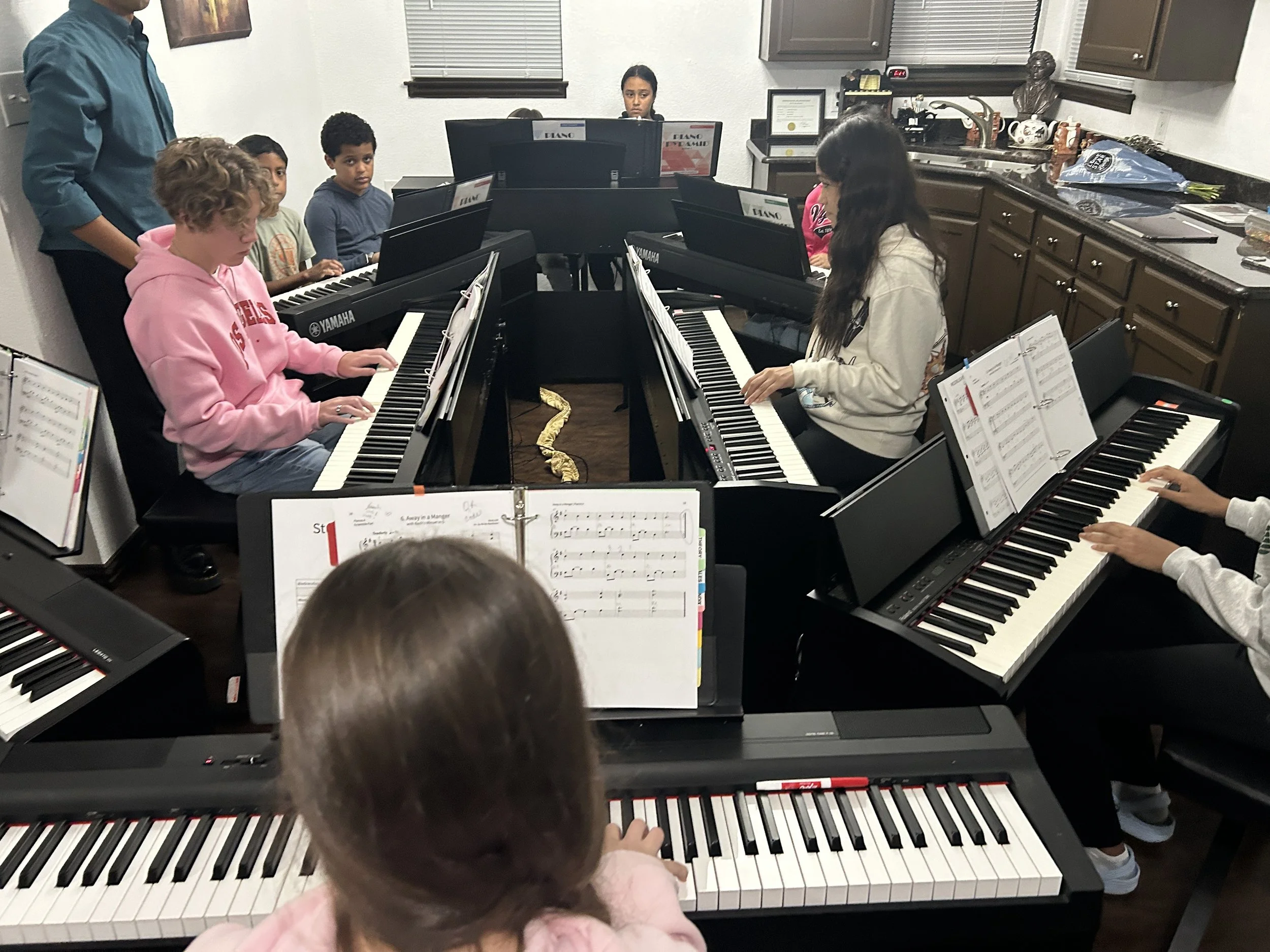
  • Group Piano classes will all be starting new books!
  • Six students have graduated from Group Piano book 6 and are now enrolled in Private Lessons.
  • Pre-piano classes have moved on to different parts of the world (musically speaking…) Meadow, Africa, Brazil, Caribbean and USA.
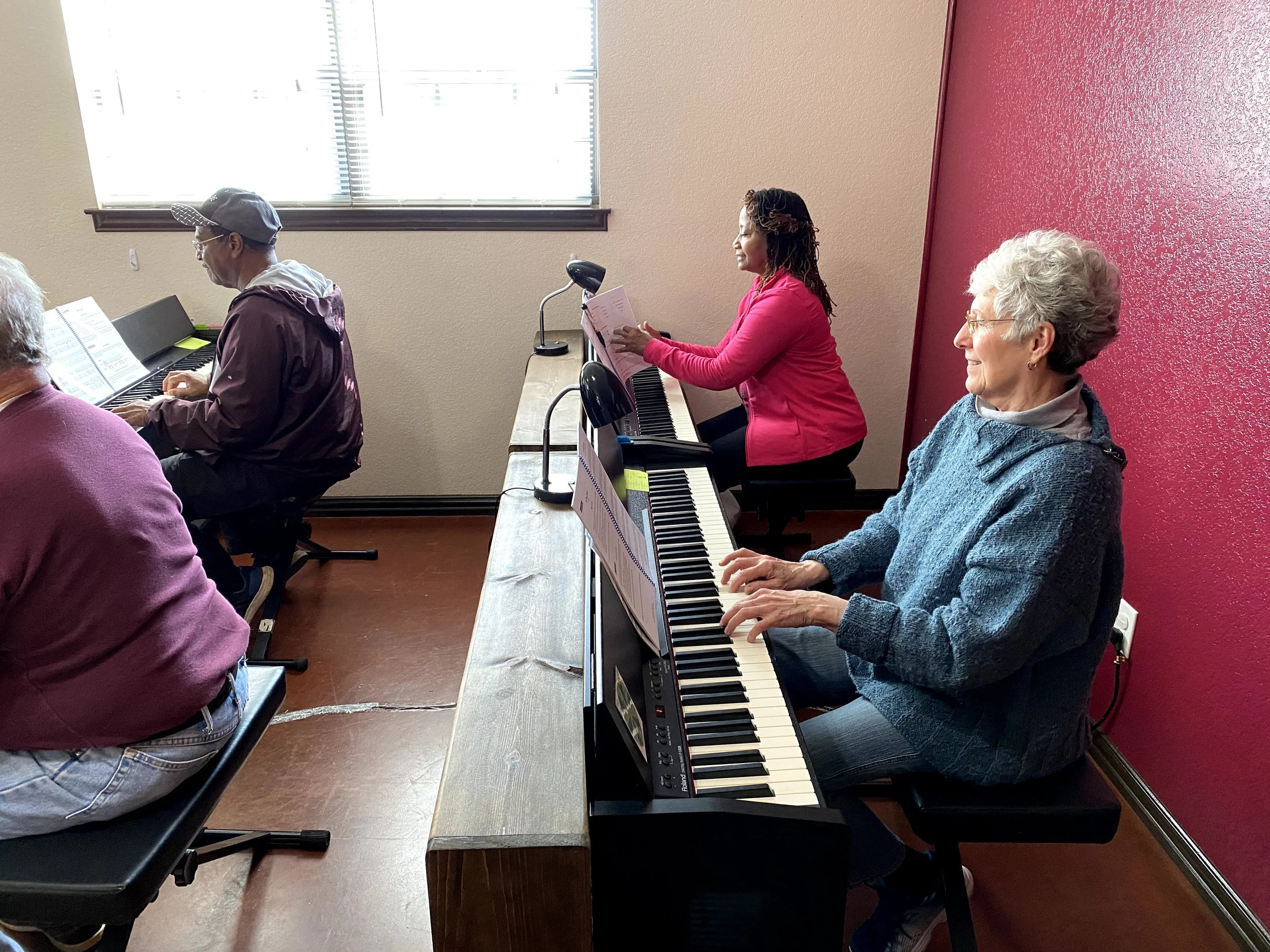
  • Adult Piano Class continues on to a new level – Book 4! (so proud of you ladies!)
  • 20 students have signed up to participate in the National Guild Auditions in the Spring.

Happy New Year!

iStock_000008484482XSmall

“The goal of [our group piano classes] is to lead children to true music literacy by means of a comprehensive musicianship course which holistically addresses both the child and the music.  Comprehensive musicianship denotes an appreciation of many facets of music – performance and improvisation (playing by ear, playing from memory, and playing from score); an understanding of rhythm, melody, harmony, and form; and an acquaintance with the historical and theoretical contexts of music.

This method offers children the gift of active and thinking music-making.  Children are offered many ways to express themselves through music- by playing the keyboard, singing, responding to music through dance, and enjoying the community of group music making.  In addition to the joy which comes from making music, they also experience the sheer enjoyment that comes from listening to great music”.

(from Music Makers: At The Keyboard, Year 2 Teacher’s Guide p. 7)